Baggage Guide · Updated June 2026
What You're Actually Allowed to Pack on an International Flight From India.
Checked and cabin baggage limits for Air India, IndiGo, Emirates, and Akasa Air — plus the 100ml liquids rule and how to avoid excess baggage fees that can cost more than the flight discount you just booked.
A flight deal tells you the route, the dates, and the price. It does not tell you how many kilos you can check in, or whether your skincare bag will get pulled aside at security. Baggage allowance depends entirely on the airline, the fare type, and sometimes the specific route — and getting it wrong at the airport is one of the most expensive mistakes a traveller can make. Here is what each major airline actually allows on international routes from India in 2026, and how to stay under the limit.
Baggage Allowance by Airline (International Routes From India)
These are approximate figures based on standard economy fares as of mid-2026. Allowances vary by fare class (Saver vs. Flexi, Value vs. Classic vs. Flex) and by specific route — always confirm the exact number on your booking confirmation before you pack.
Air India
Checked baggage varies by destination and fare: around 25 kg to Europe/UK, 25–35 kg to the Gulf depending on fare tier (Value/Classic/Flex), and a 2-piece (2 x 23 kg) concept to the US and Canada on most fares. Cabin baggage is 8 kg plus one personal item up to 3 kg. No single checked bag can exceed 32 kg network-wide.
IndiGo
IndiGo's international checked allowance is route-specific — around 20 kg to Kathmandu, up to 30 kg on Gulf, Southeast Asia, and Istanbul routes on Saver fares, and 25 kg to Europe (rising to 30 kg on UpFront/Stretch fares). Cabin baggage is 7 kg for one bag plus a separate personal item.
Emirates
Checked allowance from India runs 25 kg (Saver), 30 kg (Flex), or 35 kg (Flex Plus) in economy, 40 kg in business, and 50 kg in first. Cabin baggage is 7 kg, and from Indian airports the combined dimensions of your cabin bag cannot exceed 115 cm — a India-specific rule worth knowing before you buy a new cabin bag.
Akasa Air
On Akasa's international routes (Gulf cities, Phuket, with more destinations launching through 2026–27), checked baggage is around 30 kg in two pieces on Gulf routes and roughly 20 kg in one piece to Phuket. Cabin baggage is 7 kg plus a personal item up to 3 kg.
✓ Where did Vistara go?
Cabin Baggage vs. Checked Baggage: What's the Real Difference
The two allowances are governed by completely different rules — weight limits, what you can pack, and how strictly they're enforced at the gate versus the check-in counter.
Cabin Baggage
- ·Typically 7–8 kg for one main bag, depending on the airline
- ·Plus one personal item (laptop bag, handbag) up to 3 kg on most carriers
- ·Liquids capped at 100ml per container, all containers fitting in one resealable 1-litre bag
- ·Checked at the gate on full flights — oversized or overweight bags get tagged and sent to the hold
- ·Laptops, power banks, and medically necessary liquids are allowed without the 100ml cap (medicines need supporting documentation)
Checked Baggage
- ✓20–35 kg depending on airline, fare class, and destination zone
- ✓Some long-haul fares (US/Canada/Europe) use a 'piece concept' — a fixed number of bags rather than total weight
- ✓No single piece can exceed 32 kg on most carriers — heavier bags need to be split or pre-arranged with the airline
- ✓Liquids, toiletries, and full-size bottles are unrestricted by volume here
- ✓Sporting equipment, musical instruments, and similar oversized items usually need pre-booking and extra fees
The practical takeaway: pack anything liquid, gel, or aerosol-based into checked baggage rather than your cabin bag, unless you genuinely need it during the flight.
The 100ml Liquids Rule: What's Actually Allowed in Cabin Baggage
Every flight departing an Indian airport — domestic or international — follows the same liquids rule, enforced by BCAS and DGCA under ICAO-aligned standards. There's no exception for international routes and no special allowance for "premium" liquids like perfume.
How the 100ml Rule Works in Practice
Each container must be 100ml or smaller
It's the container size that matters, not how full it is. A 150ml bottle with only 50ml of liquid left inside is still a 150ml container and will be confiscated at security.
All containers go in one transparent, resealable bag
The standard is a 1-litre clear ziplock-style bag. Pack toiletries, skincare, and any other liquids, gels, or aerosols (sunscreen, contact lens solution, hair gel) into containers that fit inside it.
Medically necessary liquids are exempt
Prescription syrups, liquid antibiotics, insulin, and similar medically required liquids can exceed 100ml, but carry the prescription or a doctor's note — security may ask for it.
Anything liquid that doesn't fit the rule goes in checked baggage
Full-size shampoo, large skincare bottles, or duty-free liquids bought before a connecting flight should go in your checked bag, not your cabin bag, to avoid losing them at the gate.

How to Avoid Excess Baggage Fees
Excess baggage charges on international routes from India are steep enough to wipe out the savings from a good flight deal. Rates vary widely by airline and destination — IndiGo charges roughly Rs. 600 per kg on Gulf routes, Air India's international excess rates run from roughly USD 10 to USD 35 per kg depending on destination, and walk-up airport rates are consistently 30–50% higher than pre-booking the same extra weight online.
5 Ways Travellers Overpay on Baggage
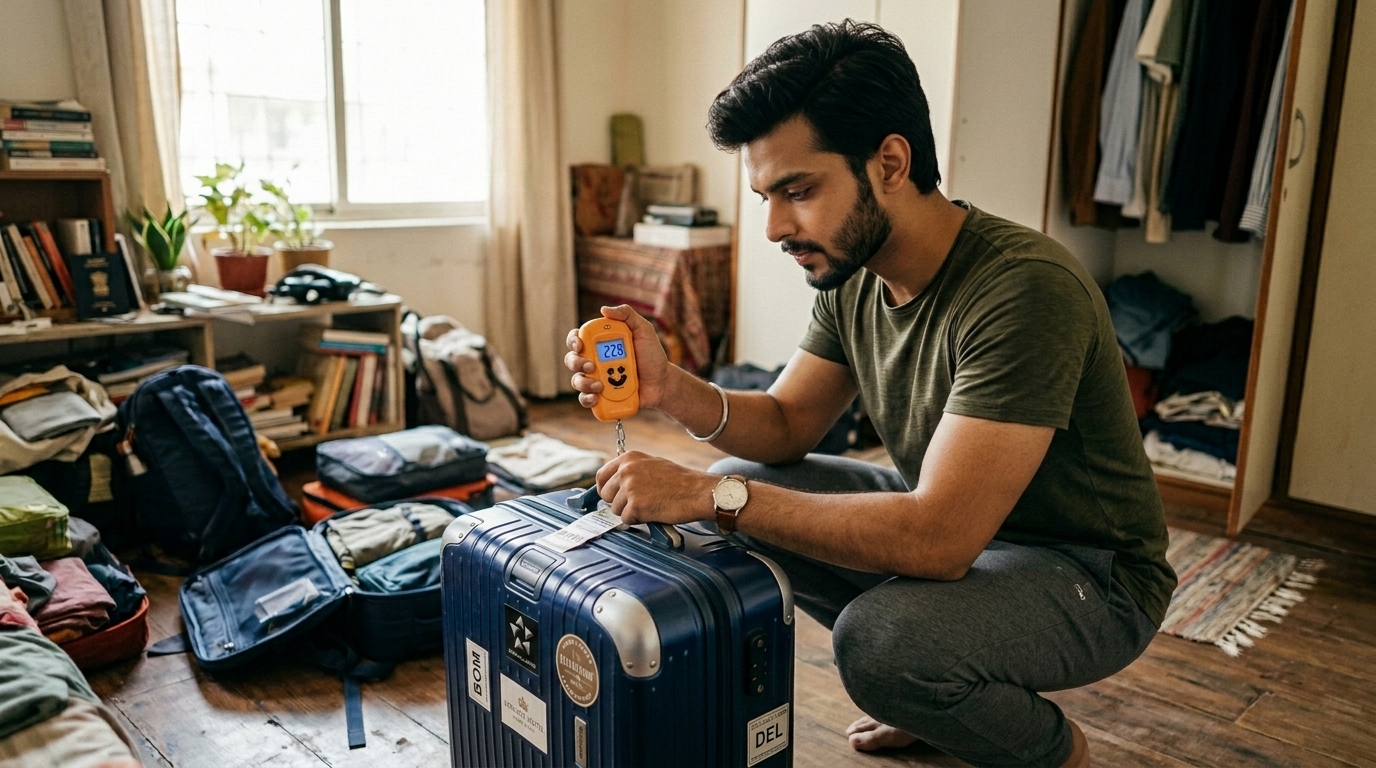
Not weighing the bag at home before leaving
A Rs. 500 luggage scale pays for itself the first time it stops you from checking in 4 kg over the limit. Weigh every checked bag before you leave the house, with margin for what you'll add at the airport (chargers, snacks, gifts).
Assuming the allowance is the same for every fare on the route
On IndiGo, Air India, and Akasa, Saver/Value fares often carry less checked baggage than Flexi/Classic/Flex fares on the identical route and flight. Check the fare rules on your specific ticket, not a friend's recent trip on the same airline.
Paying for excess baggage at the airport instead of online
Pre-booking extra weight through the airline's website or app is routinely 30–50% cheaper than paying at the check-in counter. If you know you'll be over the limit, add it online before you fly.
Forgetting that connecting flights can have a stricter allowance
If your international ticket includes a connecting flight on a different carrier or a regional partner, the more restrictive of the two airlines' baggage rules may apply for the whole journey. Check both legs, not just the long-haul segment.
Packing liquids in cabin baggage and losing them at security
Full-size toiletries and duty-free bottles bought too early get confiscated at the security check, not refunded. If it's liquid and over 100ml, it belongs in your checked bag.
⚠ Wingit shows price, route, and timing — not baggage allowance
Baggage Mistakes That Are Easy to Avoid
Beyond fees, a few baggage mistakes cause real travel-day stress — missed check-in cutoffs, items pulled at security, or bags that don't qualify as "free" at all.
4 More Baggage Mistakes to Watch For
Treating cabin and checked allowance as interchangeable
You can't move weight from an overweight checked bag into your cabin bag at the counter if your cabin bag is already at its 7–8 kg limit. Pack with both limits in mind from the start, not as a workaround at the airport.
Not checking the personal-item rule separately
Most airlines allow a personal item (laptop bag, small backpack, handbag) in addition to the main cabin bag, but cap its weight too — usually 3 kg. Overstuffing a 'personal item' to dodge the main cabin bag limit is a common reason bags get gate-checked.
Ignoring single-piece weight caps on checked bags
Even if your total checked allowance is 30 kg, most carriers cap any single bag at 32 kg, and some apply a lower per-bag cap. Two 15 kg bags clear easily; one 30 kg bag may not, depending on the airline's piece-vs-weight system.
Booking a deal fare without checking if it's baggage-restricted
The lowest fare bucket on a route sometimes carries a reduced checked baggage allowance compared to a fare just a few thousand rupees more. Read the fare rules on the booking page, not just the headline price, before paying.
Frequently Asked Questions
It depends on the airline, fare class, and destination. As a rough range across Air India, IndiGo, Emirates, and Akasa Air on economy fares in 2026: 20–35 kg checked, with Gulf and Southeast Asia routes often at the higher end and US/Canada/Europe routes sometimes using a piece-based system instead of a flat weight. Always verify the exact figure on your specific booking confirmation.
Most Indian and Gulf carriers allow 7–8 kg for one cabin bag, plus a separate personal item (laptop bag or handbag) up to around 3 kg. Combined dimensions and weight limits vary slightly by airline, so check your airline's specific cabin baggage policy before packing.
Every liquid, gel, or aerosol in your cabin baggage must be in a container of 100ml or smaller, with all such containers fitting into a single transparent, resealable 1-litre bag. This applies to every flight departing an Indian airport, domestic or international, with no exception for cosmetics or perfume. Medically necessary liquids are exempt if you carry supporting documentation.
Rates vary by airline and route — figures cited by airlines and travel sites in 2026 range roughly from Rs. 600 per kg on some Gulf routes to significantly higher on long-haul sectors, with Air India's international excess rates running from about USD 10 to USD 35 per kg depending on destination. Pre-booking excess weight online is typically 30-50% cheaper than paying at the airport counter — check your airline's baggage calculator for the exact rate on your route.
No. IndiGo's international checked allowance is generally lower and more route-specific — commonly 20-30 kg depending on the destination and fare — while Air India's allowance can run higher on certain routes and fare tiers, sometimes using a 2-piece system on long-haul sectors. Compare the specific fare rules for your route rather than assuming parity between airlines.
No. A deal price reflects the base fare for the route and dates found, not baggage allowance or any add-on fees. Baggage allowance depends on your fare class and airline, and isn't shown on deal cards. Always check the airline's baggage policy and your booking confirmation separately from the fare price.
Never miss a deal
Find the fare. We'll leave the packing to you.
Wingit alerts you the moment international fares drop 15%+ from your city. Check the route, dates, and price — then confirm baggage allowance on the airline's site before you book.
Updated June 2026. Baggage allowances vary by fare class, route, and frequent-flyer status, and change without notice — always confirm on your airline's official site or booking confirmation before packing.
Related: How to Read a Flight Deal · Economy vs. Business Class Flight Deals